

Security shows up as customer experience for ISVs

6min
Trust is built or broken in the payment flow — often long before a security incident
Customers do not separate your software from the payment experience. When something feels risky, confusing, or inconsistent, they don’t blame the provider, they blame the platform.
That’s why security decisions increasingly show up as customer experience outcomes. They’re felt in authentication steps, dispute handling, reporting clarity, and confidence about what happens next when something goes wrong.
For ISVs, the challenge is not just “being secure enough”. It’s managing risk in a way that protects trust without adding friction to already complex flows.
Why security is felt as CX, not infrastructure
Payments sit at the intersection of money, identity, and trust. Every extra hand‑off, redirect, or unclear responsibility widens what we can think of as the risk‑exposure footprint — more systems, more transitions, more places problems can surface.
Fragmented payment architectures don’t automatically create breaches. But they often create inconsistency, which customers experience as friction.
That friction shows up as:
- Extra verification steps that feel arbitrary.
- Conflicting messages about who owns disputes.
- Delays driven by uncertainty rather than processing speed.
- Support responses that depend on which system the issue surfaced in.
None of this requires a major incident to undermine confidence. Like execution friction, it accumulates quietly, until trust erodes.
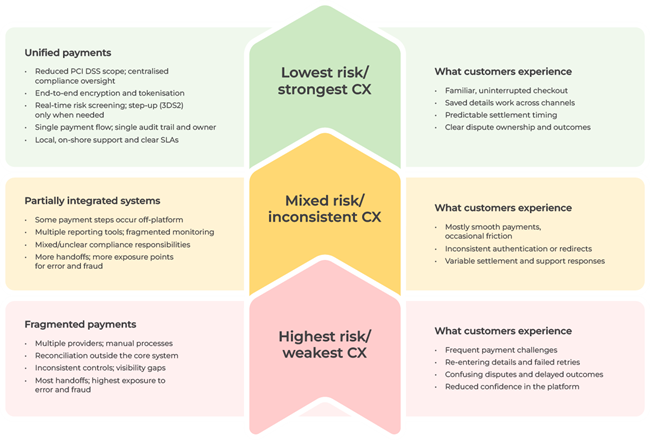
The above diagram illustrates how multiple hand-offs widen the risk-exposure footprint and create visible customer friction, compared with a more unified payment flow.
How fragmentation increases security friction
In multi‑payment provider environments, security controls are often applied unevenly across flows.
Common patterns include:
- Authentication gaps. Different rules for different payment methods or channels lead to unpredictable step‑ups.
- Blurred ownership. Disputes and chargebacks move between systems, delaying resolution.
- Fragmented monitoring. Risk signals live in separate dashboards, slowing response time.
- Inconsistent customer messaging. What customers see depends on which provider is involved.
The result is not “less security”, but less confidence — for customers and internal teams alike.
What customers notice first (security as experience)
If you want to understand how security performs as CX, look at what merchants and end customers encounter, not just audit checklists.
Key signals include:
- Inconsistent checkout steps. Security controls change depending on method or channel.
- Unclear dispute ownership. Merchants don’t know who to contact or what happens next.
- Settlement uncertainty. Confidence matters more than speed when money is in flight.
- Conflicting reporting. Teams and merchants see different versions of events.
Customers don’t label these as “security problems”. They label them as poor experience.
The priority order for CX‑positive security fixes
Improving security doesn’t require locking everything down or introducing heavy friction. The most effective fixes reduce exposure first.
1) Reduce security scope by design
Where possible, design flows so sensitive payment data doesn’t traverse or sit within unnecessary systems. For ISVs, this often starts with designing payments to reduce exposure and PCI scope, rather than enforcing heavier controls across already fragmented flows. Fewer touchpoints mean fewer controls to manage, and fewer moments that feel risky to customers.
2) Centralise audit trail and visibility
A single operational view helps teams answer “what happened and what’s next” quickly. Clear ownership shortens resolution time and avoids contradictory updates to merchants.
3) Apply adaptive authentication consistently
Security works best when risk controls are predictable. Step‑ups should feel intentional, not random, and should align across channels wherever possible.
4) Clarify dispute and settlement responsibilities
Settlement confidence is about transparency and expectation‑setting. Customers trust platforms that explain ownership and timelines clearly, even when issues arise. None of these steps require a rebuild or full consolidation. They focus on tightening what already exists.
Closing thought: confidence is the real security outcome
Strong security rarely draws attention. But inconsistent security always does.
For ISVs, the goal is not to eliminate all risk, but to reduce exposure and deliver predictable, confidence‑building experiences, especially when something goes wrong.
Key takeaways
- Customers experience security through payment flows, not infrastructure.
- Fragmentation widens the risk‑exposure footprint and creates inconsistency.
- Security friction erodes trust long before incidents occur.
- Prioritising clarity, ownership, and consistency improves CX without heavy disruption.
If your customers had to describe where payment flows feel “uncertain”, which step would they point to first? Download the ISV Payments CX Playbook to assess your current exposure points and apply the first security‑led fixes.