

Why software advantage is getting harder to defend

7mins
Software businesses have traditionally relied on new features to create software competitive advantage. Today, that advantage is becoming harder to maintain. As feature parity accelerates, Artificial Intelligence (AI) reduces development barriers and customer expectations continue to rise, differentiation is shifting away from functionality and towards workflow ownership, operational value and becoming embedded in how customers run their business.
The feature advantage era
For much of the SaaS era, competitive advantage was relatively straightforward. Build a feature your competitors didn't have. Solve a problem better than anyone else. Create functionality customers couldn't easily find elsewhere. The companies that innovated fastest often won.
Development resources were more constrained. Bringing new products to market took longer. Adding sophisticated capabilities often required significant investment, specialised expertise and years of iteration. As a result, product innovation created meaningful separation between competitors.
A new reporting capability, automation workflow or customer experience improvement could remain differentiated for extended periods, helping software businesses attract and retain customers while building market share. In many software categories, product roadmaps became the primary source of competitive advantage. And being able to do something competitors could not was often enough.
Why feature-led differentiation is becoming harder
That environment has changed significantly. Software innovation has accelerated across virtually every category. Development tools have matured. Cloud infrastructure has lowered barriers to entry. AI is dramatically reducing the time required to design, build and deploy new capabilities, allowing competitors to narrow feature gaps faster than ever before.At the same time, customers have become increasingly sophisticated. Capabilities that once felt innovative are now considered baseline requirements. Users do not compare your platform only against direct competitors. They compare every experience against the best software they use every day. This creates a challenge many software businesses recognise: the gap between innovation and imitation continues to shrink.
This shift is creating new challenges for SaaS differentiation, particularly in mature software categories where competitors can quickly close functional gaps.
What once took years to replicate can now often be matched in months. External SaaS industry commentary increasingly points to the same trend, arguing that sustainable advantage is shifting beyond functionality and towards execution, workflow ownership and operational value.
The result is that software companies can find themselves investing heavily in features that quickly become expected. Competing on functionality alone becomes an increasingly difficult way to create lasting differentiation.
The real shift is happening elsewhere
As software categories mature, advantage often moves beyond functionality itself. Customers don't simply buy features. They buy outcomes, efficiency and confidence. They buy solutions that make their businesses easier to run.
For many organisations, software differentiation is becoming less about individual features and more about the value created across customer workflows and business operations.
The most valuable platforms often win not because they have the longest feature list, but because they become deeply embedded in the way customers operate. By removing friction, simplifying complex processes and connecting critical activities, these platforms become increasingly difficult to replace because they sit at the centre of important daily workflows.
The competitive advantage is no longer the feature itself, the advantage comes from the role the platform plays within the customer's business.
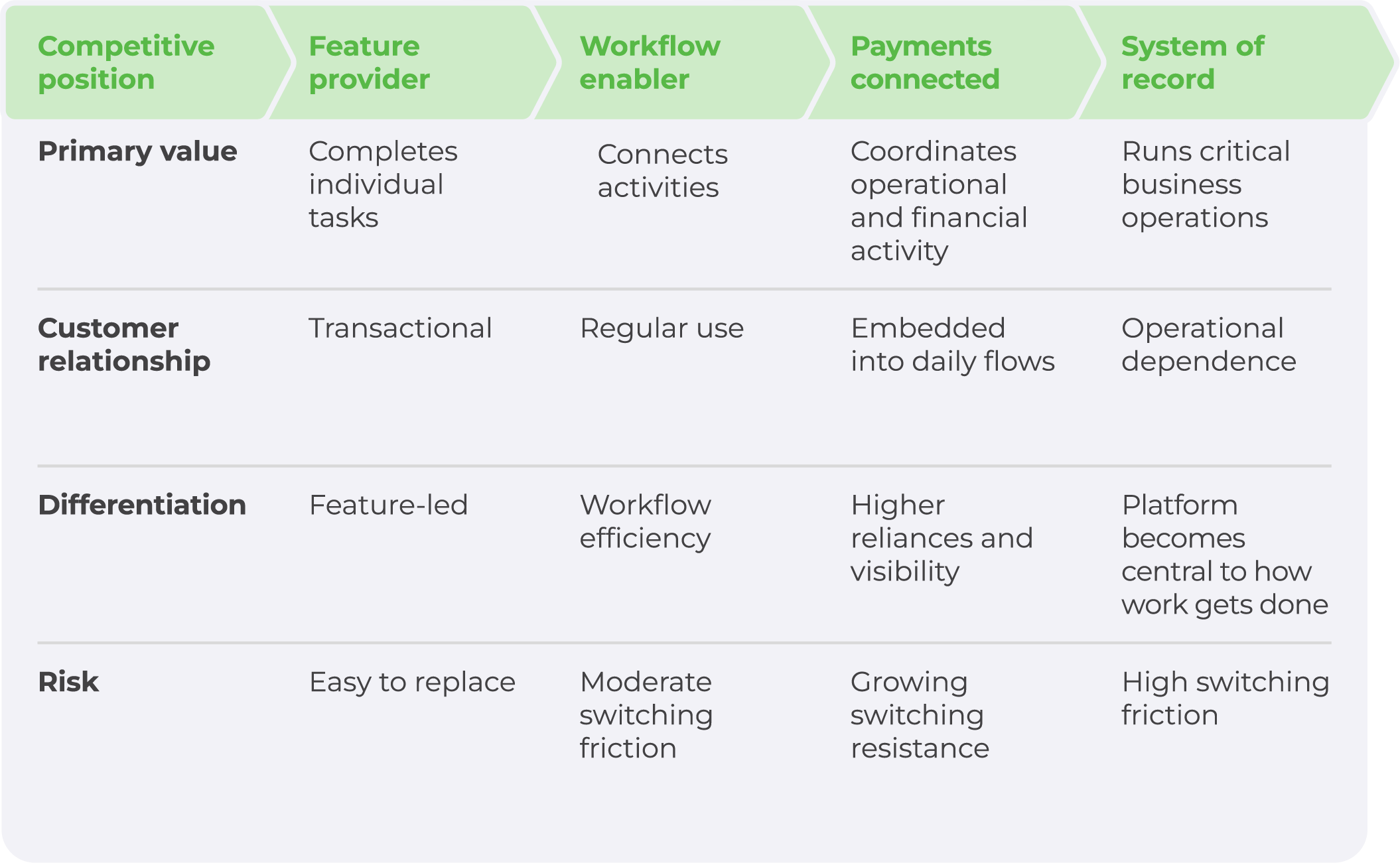
This shift can be seen in how software platforms evolve from delivering individual functionality to becoming embedded in critical business operations and workflows.
Workflow ownership creates stronger positions
Consider the difference between a feature and a workflow. While features solve specific problems, workflows support broader business processes. Features can often be replicated relatively quickly, whereas workflows become progressively harder to displace once they are embedded in how customers operate.
When a platform becomes connected to processes such as onboarding, scheduling, reporting, reconciliation, communications or revenue collection, its value extends beyond individual functionality. The software becomes part of how the customer operates.
This often leads to deeper engagement, stronger operational dependence and longer-term retention.
Increasingly, SaaS competitive advantage comes from becoming embedded in the processes customers rely on every day rather than from standalone functionality.
Many software businesses are already starting to focus on broader strategic questions:
- Which workflows matter most to our customers?
- Where do we create the greatest operational value?
- How can we become more deeply embedded in day-to-day activities?
- Which capabilities strengthen long-term customer relationships?
These questions move beyond product development and into business strategy.
Looking beyond the product roadmap
None of this suggests software companies should innovate less. Customers still expect products to evolve and improve. And feature development remains critical. The difference is that functionality alone is becoming a less reliable source of sustainable advantage.
Long-term differentiation increasingly comes from helping customers achieve outcomes that are difficult to replicate elsewhere. That may come through workflow ownership or operational integration. Or it may come through capabilities that influence how customers generate revenue, serve their customers or manage critical business processes.
What matters is recognising that advantage is becoming broader than software features alone. As software categories continue to mature, understanding where durable value is created may become just as important as understanding what functionality to build next.
One area increasingly moving into this strategic territory is payments. Unlike many software capabilities that sit adjacent to customer operations, payments sit inside customer workflows and revenue generating processes. As a result, they can create a level of operational integration and business value that is difficult to replicate through features alone. As software businesses look beyond feature-led differentiation, payments are becoming an increasingly important part of the competitive advantage conversation.
Strategic takeaways
- Feature parity is accelerating across SaaS markets.
- Customer expectations are rising faster than traditional product roadmaps.
- Sustainable advantage and differentiation increasingly comes from workflow ownership and operational value.
- Businesses embedded in everyday customer operations are harder to replace.
- Competitive advantage is expanding beyond functionality and towards customer outcomes.
What next?
Download the ISV Payment Advantage eBook to explore how software businesses can identify where to find durable competitive advantage.