

Fragmented payments slow how ISVs ship and scale
.jpg?h=1093&iar=0&w=1639&rev=bd6f5f4e07ff448e9a7d0d205eae376d)
5mins
Execution friction compounds long before anything breaks — and it doesn’t require a rebuild to fix
Most payment stacks don’t fail in spectacular ways. They slow down quietly — across product delivery, support resolution, reporting, and the customer experience you’re judged on.
That matters because payments are no longer “just rails”. They’re part of the experience your customers buy, and the experience your merchants blame when something feels off. In the Australian SMB Payment Pulse, 75% say customers encounter friction somewhere in the payment process, and businesses spend 22.6 hours per week on payment-related admin.
For ISVs, that friction is costly, especially when it’s distributed across multiple tools and providers.
Where the hidden tax shows up (and why it compounds)
Fragmentation often starts with good intent: add a provider for a method, a channel, a use case, a region, an enterprise buyer requirement. Over time, you inherit overlapping systems and inconsistent flows.
Here’s where the “tax” commonly appears:
- Product and engineering drift. Different providers update on different schedules. You end up maintaining parallel logic, multiplying test paths, and carrying version drift that slows releases.
- Support complexity. Inconsistent error handling and retry logic makes triage harder. Vendor hand-offs can blur ownership and stretch time-to-resolution.
- Finance and reporting workarounds. Reconciliation can move outside the platform, with teams stitching together reports and chasing edge cases.
- Customer experience drop-offs. Redirects, retries, re-entering details and uneven authentication can add friction at the worst moments.
Taken together, these issues all stem from low cohesion across the payment experience. When flows are inconsistent and ownership is fragmented, journeys become less intuitive for customers and harder to reason about for integrators. Over time, that lack of cohesion drives higher effort to maintain, increases support overhead, and ultimately raises the cost to serve and operate the platform.
None of this requires a single outage to hurt you. The drag compounds: slower roadmap, higher support load, and lower confidence in adding new payment capabilities.
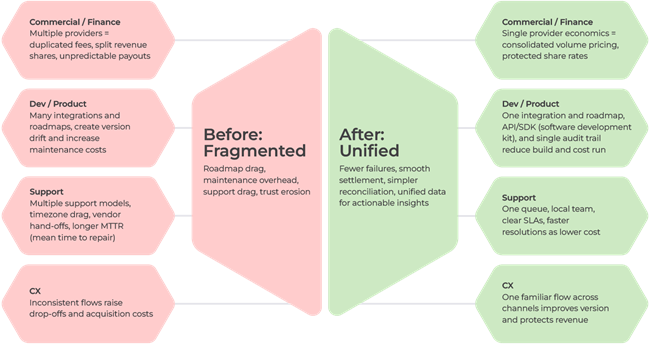
The above image illustrates the before and after of how fragmented payment stacks create operational drag across product, support and customer experience, compared with a unified flow.
How to spot fragmentation from the outside (merchant signals)
If you want a practical tell, look for symptoms your merchants experience — not just what your team sees internally.
- Inconsistent steps at checkout. Different flows for different methods or channels create “why did it do that?” moments.
- Unclear dispute and support ownership. When something goes wrong, merchants don’t separate the platform from the payment partner.
- Opaque settlement expectations. This is about clarity, predictability, and confidence in what happens next.
- Reporting mismatch. If merchants and your teams can’t see the same “source of truth”, resolution time inflates.
The stakes are commercial as well as operational. In practice, most ISVs operate multi‑vendor payment stacks. In our recent ISV survey, we found 89% of ISVs manage integrated or partially integrated payment stacks — and many are actively re-evaluating partners.
The first three fixes (a low-risk starting point)
You don’t need to start with a full consolidation project. Start by reducing avoidable complexity and making the current state visible.
This is why many platforms start by integrating payments directly into business software, rather than adding yet another tool around the edges.
1) Map the end-to-end payment journey as customers experience it
Document the flow across onboarding, payment, reconciliation, payouts, refunds, and disputes — including where customers are redirected off-platform and where teams rely on manual workarounds.
2) Standardise error handling and “what happens next”
The goal is consistency: fewer surprises, clearer messaging, and fewer paths that send customers into retries and dead ends. Even small alignment on failure states can reduce support load.
3) Centralise reporting views, even if providers remain multiple
You’re aiming for one operational lens: a single audit trail mindset, consistent reconciliation outputs, and shared visibility between product, support, and finance. If you do only these three things, you usually learn where duplication is costing you most — and you create the baseline you’ll need to measure improvement later.
Closing thought: simplify what you can control
Payments complexity is not always optional. But fragmentation’s hidden tax is. The fastest path to progress is often not “switch everything”, but “remove the duplication and uncertainty that taxes every team, every day”.
Key takeaways
- Fragmentation usually harms growth through daily operational drag, not major failures.
- Customer experience friction and admin burden are real and measurable.
- Standardising failure states and reporting reduces support load and uncertainty. The best starting point is visibility: map flows, then simplify.
If your team had to explain your end-to-end payment journey on one page, where would the hand-offs and inconsistencies show up first?
Read our guide on how unified payments deliver real outcomes for ISVs including what to consolidate, what to keep separate, and how to reduce fragmentation without disruption.
The Playbook also explores how Ezidebit and Global Payments’ payment capabilities help ISVs reduce fragmentation by supporting consistent experiences across online, recurring, and in‑person channels.